Industrial Automation
Find OMRON solutions based on your industry
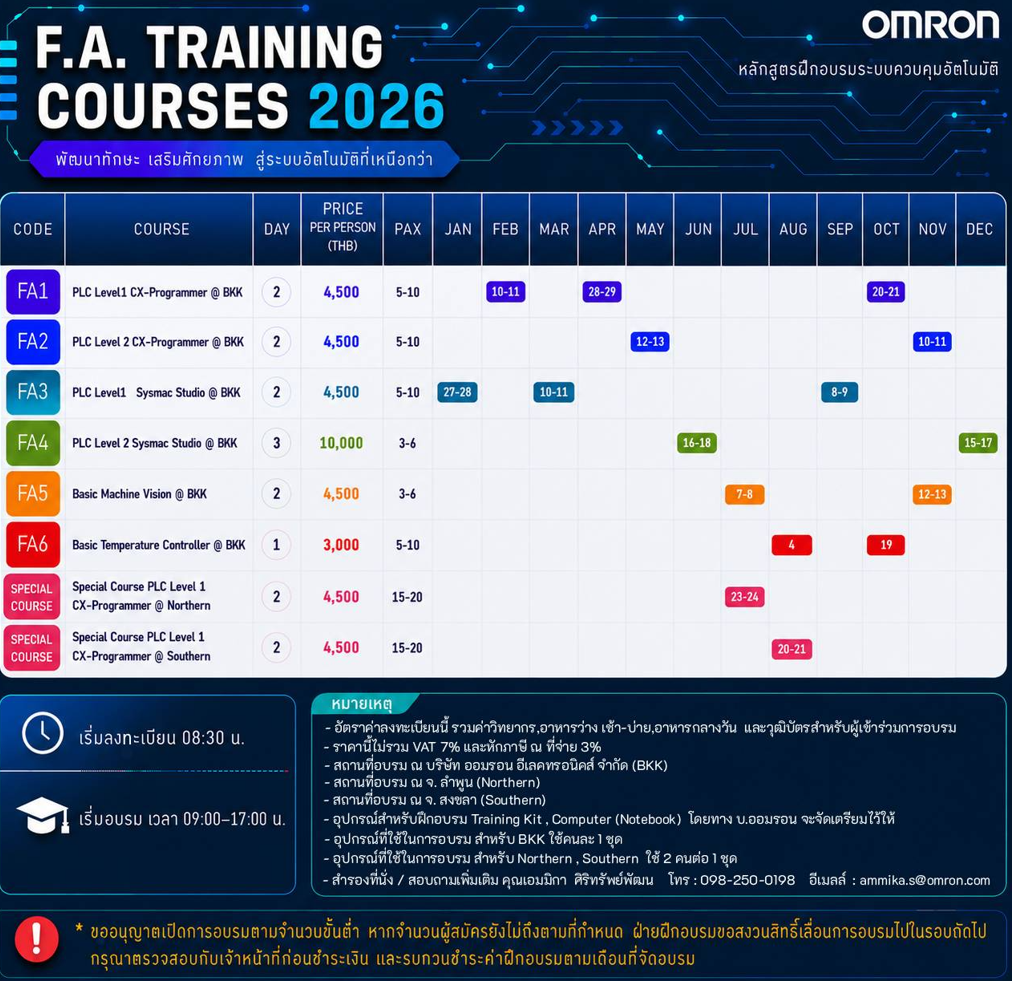
OMRON Thailand’s training schedule.
FA1 – PLC Level 1 (CX-Programmer) Course introduces participants to the basics of automated control systems using PLCs as the primary control device. This course is suitable for beginners or professionals seeking to refresh their foundational knowledge. The course details cover the core principles and basic usage of PLCs. Participants will be able to understand the differences between Relay-based control logic and PLC-based control configurations. Participants will also be able to apply the knowledge gained to work with other PLC models and develop their own PLC programming skills.
2 Days Registration 8.30 AM.
4,500 / Person (Exclude VAT 7% and withholding tax 3%)
5-10 persons
CP1L
FA2 – PLC Level 2 (CX-Programmer) course is suitable for those with basic knowledge or who have successfully completed the FA1 – PLC Level 1 (CX-Programmer) Course. The course content covers various theories of automatic control, such as ON/OFF control, Proportional (P) control, Integral (I) control, Derivative (D) control, and PID control, to build a foundational understanding of control units for participants.
This course will focus on enabling participants to work with PLCs that can receive analog signals for both input and output units, as well as programming methods that control various types of input/output devices. Additionally, participants will learn special commands to simplify the complex systems logic and be introduced to various types of special input/output units and PLC communication systems.
2 Days Registration 8.30AM.
4,500 / Person (Exclude VAT 7% and withholding tax 3%)
5-10 persons
CJ2M
FA3 – PLC Level 1 according to IEC 61131-3 Standard (SYSMAC Studio) course focuses on utilizing the Sysmac Studio software package. The curriculum is designed to introduce participants to the fundamentals of industrial automation control systems, featuring NJ and NX Series PLCs (Machine Controllers) as the primary control device.
This course is suitable for beginners starting their journey or professionals seeking to refresh and strengthen their core foundational knowledge. The course covers the fundamental operating principles and practical applications of the NJ and NX series. Participants will learn to understand the differences between relay-based control logic and PLC-based control configurations using the NJ and NX platforms.
Participants will be able to apply the knowledge gained to various industrial control applications. Furthermore, the training approach is structured to empower attendees to independently develop, advance, and scale their own PLC programming models for NJ and NX Series controllers.
2 Days Registration 8.30AM.
4,500 / Person (Exclude VAT 7% and withholding tax 3%)
5-10 people (For Bangkok center)
15-20 people (For Lamphun and Songkhla center)
NX1P
FA4: PLC Level 2 according to IEC 61131-3 Standard (SYSMAC Studio) course utilizing Sysmac Studio software is suitable for individuals who have successfully completed the PLC Level 1 according to IEC 61131-3 Standard (Sysmac Studio) training course.
This course will focus on the in-depth architecture of the entire memory area, graphical analysis and theories of automatic control such as ON-OFF control, Proportional (P) control, Integral (I) control, Derivative (D) control, and PID control, along with engineering unit scaling to understand quantitative process control principles.
Participants will be able to master analog I/O configuration (both input and output processing) and program controls for diverse analog field devices. Furthermore, participants will learn special command to simplify complex system logic and receive a comprehensive introduction to modern industrial network communications compliant with the IEC 61131-3 standard.
3 Days Registration 8.30AM.
10,000 / Person (Exclude VAT 7% and withholding tax 3%)
3-6 people
NX1P
FA5: Fundamentals of Vision Sensors and Applications course is designed to provide participants with a comprehensive understanding of image processing principles using vision controller software, specifically for integration with PLCs.
The curriculum introduces participants to image processing fundamentals, inspection processes, system configuration, and the practical application of vision tools including the examples of commonly used function for each type of industry. In detail, the course covers the classification, selection, and optimization of inspection results using specific vision tools. Upon completion, participants will be able to apply this knowledge to design automated and smart manufacturing production systems.
2 Days Registration 8.30AM.
4,500 / Person (Exclude VAT 7% and withholding tax 3%)
3-6 people
FQ2 Smart Vision
FA6: Fundamentals of Temperature Controllers and Applications course is designed to
provide participants with a comprehensive understanding of the core operating principles
and fundamental concepts of thermal control systems. The curriculum covers initial device
configuration, input sensor types, and the characteristics of various control outputs.
Participants will gain hands-on experience configuring different functions to achieve
optimal temperature stability and control loop performance. Furthermore, the course is
structured to empower attendees to independently apply these configurations, adjust
parameters, and optimize machinery setups on the factory floor.
1 Day Registration 8.30AM.
3,000 / Person (Exclude VAT 7% and withholding tax 3%)
5-10 people
Temperature Controller
COPYRIGHT 2024 @ OMRON CORPORATION. ALL RIGHTS RESERVED.
| Cookie | Duration | Description |
|---|---|---|
| cookielawinfo-checbox-analytics | 11 months | This cookie is set by GDPR Cookie Consent plugin. The cookie is used to store the user consent for the cookies in the category "Analytics". |
| cookielawinfo-checbox-functional | 11 months | The cookie is set by GDPR cookie consent to record the user consent for the cookies in the category "Functional". |
| cookielawinfo-checbox-others | 11 months | This cookie is set by GDPR Cookie Consent plugin. The cookie is used to store the user consent for the cookies in the category "Other. |
| cookielawinfo-checkbox-necessary | 11 months | This cookie is set by GDPR Cookie Consent plugin. The cookies is used to store the user consent for the cookies in the category "Necessary". |
| cookielawinfo-checkbox-performance | 11 months | This cookie is set by GDPR Cookie Consent plugin. The cookie is used to store the user consent for the cookies in the category "Performance". |
| viewed_cookie_policy | 11 months | The cookie is set by the GDPR Cookie Consent plugin and is used to store whether or not user has consented to the use of cookies. It does not store any personal data. |